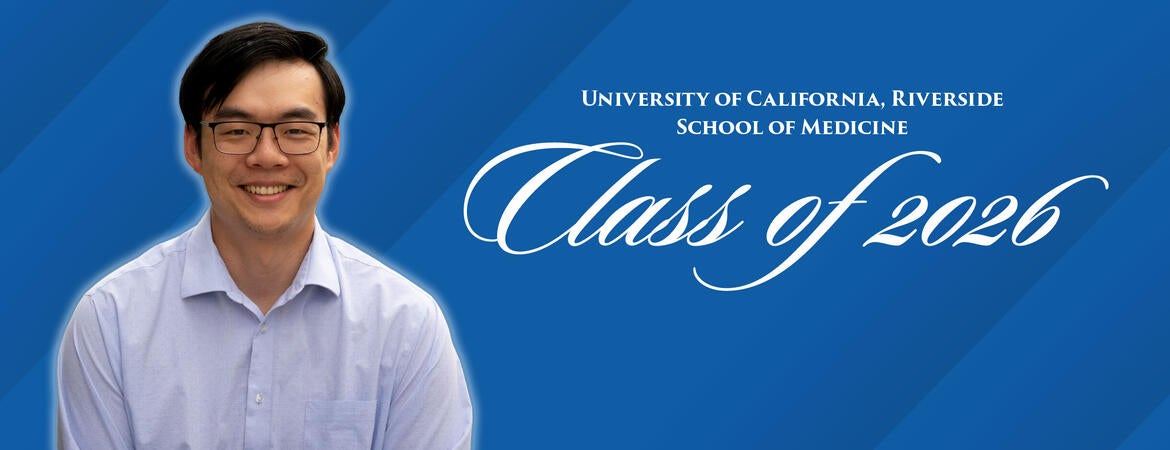
As an emergency medical technician (EMT) from 2017 through 2019, Andrew Huang routinely saw seizures as one of his most common calls. He treated several patients in car accidents only to be dispatched to their houses a week later when they had a seizure; other calls were for patients hit on the head with a baseball bat and febrile seizures in children.
Despite the frequency of these calls, Huang could do little to help. “You can provide them with anticonvulsants and you can help make them comfortable, but there's not much we can do for the long-lasting effects,” recalled Huang, who will graduate this summer with a PhD in biomedical sciences from the UC Riverside School of Medicine.
The sheer number of calls for head and brain injuries ignited Huang’s desire to find new ways to help patients. “That ultimately drove me into doing research, because I wanted to understand the changes in neural circuitry underlying these conditions and develop targeted, long-term solutions,” he said.
But Huang also wanted to help patients in a more immediate way as a physician. Rather than choosing just one path, he decided to do both. When he graduates with his PhD this summer, he’ll also start his second year of medical school at Virginia Tech Carilion School of Medicine.
Research for long-term impact
Huang’s unique path began at UCR when he was an undergraduate majoring in neuroscience. “I always thought it was really interesting to see how the brain works,” he said. “Seeing a lot of people with Alzheimer's, Parkinson's, and dementia drew my interest as to what we could do to help them get better.”
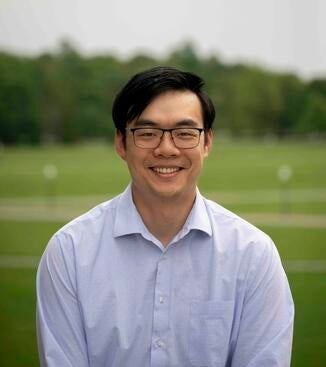
After earning his bachelor’s degree, Huang knew he wanted to help patients but wasn’t sure of the best way to go about it. Becoming an EMT, he said, provided him the opportunity to work directly with patients while getting hands-on experience. Huang’s time as an EMT and his curiosity about finding new ways to aid patients drove him to earn his PhD, while epilepsy research by Neuroscience Graduate Program Director Viji Santhakumar, PhD, drew him back to UCR in 2019. “It was a huge step in my life to do something that combines my scientific curiosity with my long-term commitment to improving patient lives,” Huang explained. “The PhD program felt like the right place for me to obtain the skills for translational research.”
Huang’s doctoral research focused on circuit mechanisms underlying memory processing and ways it's disrupted in epilepsy. He received an American Epilepsy Society Predoctoral Research Fellowship in 2022, which included a $30,000 award to help fund his research, as well as the Ruth L. Kirschstein National Research Service Award Individual Predoctoral Fellowship (F31). “I couldn't have gotten them without the support of Dr. Santhakumar and the supportive postdoc Dr. Subramanian--they were absolutely instrumental in me getting those awards and helping me flesh things out and trying to learn how to think like a scientist,” he said, referring to Deepak Subramanian, an assistant professional researcher and neurobiologist at UCR who focuses on traumatic brain injury. Huang hopes to focus on health and memory issues associated with disease in future research.
"Andrew is a very careful, thorough, meticulous scientist," Santhakumar said. "He really loves to learn and has really sought out every opportunity possible."
Huang has enjoyed sharing his research and knowledge. “Every year, I’ve been involved in UCR’s Brain Awareness Day, and it’s always a lot of fun showing middle and high schoolers how the brain works, whether it’s how we can harness it for prosthetics or explaining what a neuron does,” he said. Huang also received a distinguished teaching award and outstanding teaching award as a teaching assistant in undergraduate UCR neuroscience courses. “Those awards really reflect the importance of providing every student with the attention and guidance as needed,” he said. “If I can make it fun and approachable for the next generation, it’ll hopefully make the material easier to grasp and maybe even spark their interest in pursuing neuroscience, neurology, neurosurgery, or anything brain-related.”
Treating patients for immediate impact
Attending conferences during his doctoral program gave Huang insights into pursuing his goal of academic medicine. “I'd like to run a lab, I'd like to be in clinic, I'd like to teach… and I just want to make as much of a difference as I can, either training the next generation of physicians, or seeing what types of ailments are in the community, and then trying to focus my research on it,” Huang explained. “Hearing from established physician-scientists reinforced my commitment to this path.”
Huang applied to medical school during the sixth year of his PhD program and was accepted at Virginia Tech, where he enrolled during the final year of his PhD program. “I can envision the long-term impact of research and how I could help people, but the one thing I really missed was the patient connection,” he said. “During my EMT days there were really hard moments, but being able to help people in the community and be there for them during some of their worst moments was extremely gratifying. Having the opportunity to be trained in both those things in parallel feels wonderful and an absolute privilege," he said.
Now heading into his second year of medical school, Huang hopes to focus on neurosurgery and neurology but remains open to other specialties like ear, nose, and throat or cardiology. "We still understand very little about the highly complex human body,” he explained. “That intersection of established medicine and open scientific questions is where my curiosity thrives and is where I feel I can truly make the largest difference.”
Maximizing his impact in medicine
With a PhD and, soon, an MD, Huang plans to use his knowledge to uniquely help patients by bridging the gap he’s observed between clinical practice and scientific discovery. “I’ve been extremely fortunate to meet several inspiring physicians who work every day to better patients' lives through science,” he said. “My goal is to continue with that mission: to be a clinician-scientist who can identify clinical challenges, drive translational research, and ultimately improve patient outcomes. That alignment between patient care and scientific inquiry is exactly why I’m here.”
“That medical school grounding will probably give him more of a clinical appreciation for the questions he's asking,” Santhakumar said. “I do see him as someone who will not… give up on the bench work, because he does really enjoy it, and excels in it.”
“Being in that middle ground is kind of scary, but I think it's necessary,” Huang continued. “At the end of the day, everybody has the same goal of ridding people of ailments, pains, and sicknesses, so that people can go on and live their lives,” he added. “By working at the intersection of research and clinical practice, I hope to continue bringing novel scientific insights to the patients who need them.”
Each goal serves Huang’s overall purpose of helping as many patients as he can. "I want to reduce the burden of disease for people through innovation," he said, "and ensure patients know there is always someone there for them."