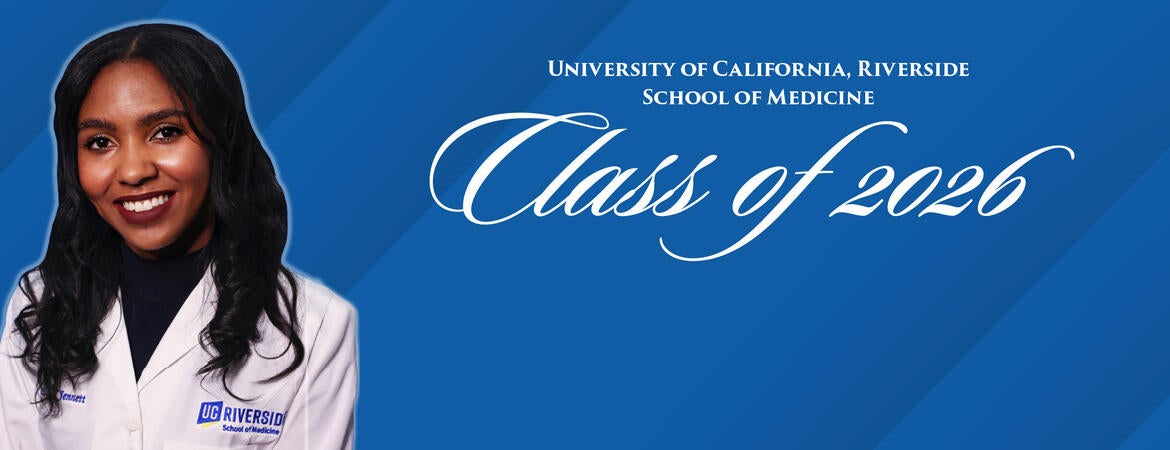
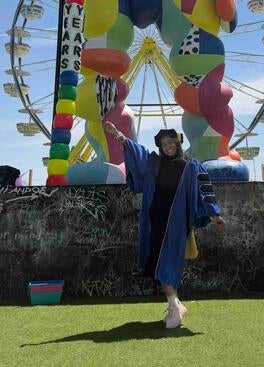
After studying microbiology in college in Arizona, Jennell Jennett considered becoming a doctor. Yet while working in a primary care office after earning her bachelor’s degree, she soon understood that it wasn’t her ideal career choice. “I realized direct patient care maybe wasn't for me,” recalled Jennett, who will graduate with a PhD in biomedical sciences from the UC Riverside School of Medicine in June. “There wasn't enough science I was able to do every day.”
She happened to start a job in biotechnology--and found her true calling. “I ended up loving it. I just knew… this is definitely what I want to do,” Jennett said. “Understanding the questions you have to life and just the earth and everything around you, I find that really cool.”
Recognizing Jennett’s desire to have more control over her research, her boss recommended that she apply for PhD programs. She enrolled at UCR in 2021, joining the lab of Associate Dean for Biomedical Research Meera G. Nair, PhD.
Pursuing science at the UCR SOM
In Nair’s lab, Jennett’s research has focused on immunology and host immune responses to infection. One of her recent projects, in collaboration with the UCR Center for Cannabinoid Research, examined how cannabis exposure may alter immune responses during parasitic infection, with the goal of identifying broader implications for human health.
Another of Jennett’s current projects with Nair has focused on the link between helminth (parasitic worm) infections, diet, and weight loss. “She found that triggering a type two immune response through helminth infection could protect mice from a Western diet and could make them less diabetic,” Nair explained of the research. She added that using mice as a model has a direct translation to humans. “The novelty in what Jennell did was really taking into account a physiologic model that better represents a public health crisis, which is obesity driven by diet–and not only that, she identified an immune mechanism that's protective through worm infections,” Nair said.
The project led to Jennett working to develop a potential treatment. The idea, Jennett explained, was to create a stem cell therapy that replicated the effects of a parasitic infection with the goal of reducing obesity. “The concept was really cool, utilizing what we see naturally occurring in our environment and being able to harness that technology and use it in a way that can be very beneficial for treating other diseases and disorders,” she said.
While the final product showed some success, it didn’t work well enough to continue with development. “That's the fun of science, is all the surprises,” said Jennett, who plans to publish a paper with her findings. “It doesn't disappoint me or anything at all--if anything, you always learn something, and… that way people don't do the same things over and over again,” she added. “Even if things don't work, I think there's benefit in that.”
Helping the community
Whether a certain project is successful or not, Jennett pointed out that it contributes to her and other scientists’ underlying purpose of making a positive impact. “If things work, you're like, ‘Wow, that's awesome, I hope this can help people moving forward,’” she said. “We want to see diseases treated. We want to see people living better lives. So however we can get closer to that goal, we get excited about it.”
Some of Jennett’s UCR research has focused on helping Inland Empire residents, furthering the SOM’s mission to improve health in the region. Working as a clinical graduate student researcher at UCR Health, Jennett studied the effects of a mother’s sleep on her breastmilk quality by analyzing samples provided by women in the area. “No one thinks about how the mom is doing and how that affects the baby and also the mom long term, so that was a very interesting study,” she said. Another of her projects assessed pediatric medical records to identify effective treatments for genetic obesity and type 1 diabetes to benefit children in the region.
As a first-generation student, Jennett also volunteered her time as a graduate student mentor to give back to students in similar situations. “I'm so happy that I know things now that I can tell them, because I had to dig for information sometimes… so being able to make that a little bit smoother for them is really nice,” she said. She listed academic questions like understanding the thesis defense process and broader questions like achieving work-life balance as examples. “Grad school is pretty hard, but having that support helps a lot, and just knowing that you're not alone and you have people who've been doing the same things that you have and the same struggles,” Jennett said.
She has also inspired even younger potential scientists by giving demonstrations at grade school science fairs. “We look at microscopes all day so we forget the magic sometimes, but for those kids, that's the only time they've seen a microscope,” she said. Jennett recalled students’ dismay over blurry views of microscope slides and their excitement when the slides came into focus. “It’s getting kids inspired in science and showing how cool it could be and all the things that you can do with it, because I know at that age, I wasn't sure what a career in science really meant,” she said.
With her breadth of interests, Jennett has applied for a range of jobs in Southern California, from drug development for immune targets to personalized medicines for cancer. “I don't get too attached to any one thing, because I always feel like there's more things to learn,” she said. “I'm totally fine switching gears and just seeing where the next adventure takes me and getting to learn more about something that I didn't know before.”
She emphasized that anyone can follow their interest in science to pursue it as a career. “I don’t come from your standard scientist background--my mom’s a travel agent and my dad’s in the air force, and they’re immigrants from Belize,” Jennett said. “If you love something enough, you can make it happen.”