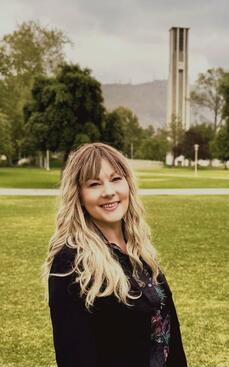
Alicia Junker knew she wanted to focus on veterans health for her Master of Public Health (MPH) thesis at the UC Riverside School of Medicine. But initially, Junker, a member of the MPH program’s inaugural class of 2026, had trouble choosing a specific topic.
In memory of a friend and fellow veteran who passed away several years ago from lung cancer, Junker decided to focus on burn pits. “When you are a soldier and you're asked to go to war, you think, ‘I could get shot, I could develop PTSD’--but no one thinks that 10 years from now, you’re going to die because there were toxic chemicals that you were breathing in, especially if you didn't even work near the burn pits,” she said.
Junker explained that the practice of burning trash and plastics produced smoke throughout military bases, often leading to future health conditions for those in the vicinity. “I even think about contractors and civilians who were working on base and their exposure, so for me, it's a health equity issue,” she said.
Sharing veterans’ unique stories
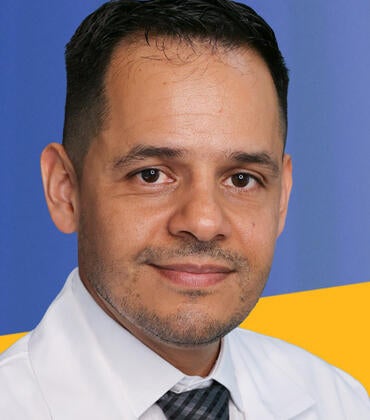
Alongside her thesis advisor Daniel Novak, PhD, director of student scholarly activities at the UCR SOM, Junker began reviewing public online forum posts and video testimonials from veterans experiencing health issues linked to burn pits. They categorized and analyzed them with the goal of identifying themes to help address veterans’ ongoing health challenges.
"I think Alicia bringing awareness to it from her position as a veteran and as somebody who has worked in the armed forces with folks affected by burn pits is a really great perspective,” Novak said. “She's doing a great job of really investigating the human dimension of this issue, and hopefully, by starting out with a small study like this, it'll encourage other people to conduct a larger study,” he added. “Our program is proud to support scholars like Alicia as she makes a difference both in school and as a future public health leader."
Beyond offering insights into veterans’ health needs, Junker aims to use her research to help community members see veterans as other people just like them. She recalled service members being unwelcome at the funeral of her veteran friend, a liberal woman from Portland, who died from cancer. “Some people look at the military and the government as the enemy, but they don't think about the individual soldiers being people who are part of their communities,” Junker said. “We have complicated stories to tell. We're moms, we’re LGBTQ, we’re Black or Asian--veterans encompass every population,” she continued. “I want to really uncover the intersectionality of that and humanize us.”
A self-described hippie from Portland, Junker herself presents a different image from commonly held perceptions around the word “veteran.” “When you first meet people and you tell them you're a veteran, they assume certain things,” she said. “Number one, people assume that veterans are old white men, and that's just not the case; veterans represent every community.”
Junker has frequently seen and heard assumptions like these throughout her experience in public health. As the sole veteran in her job at Riverside University Health System Public Health (RUHS-PH) and in the 2026 MPH cohort at the UCR SOM, she strives to help raise awareness of veteran issues while learning from others at the same time. “It's nice to be able to break down those barriers and really get to know each other on an individual level,” she said. “I love being part of those spaces, and I love learning about other people and their cultures and their experiences.”
Graduating with a full-time job, military duty, and cancer
As with other service members, Junker’s veteran status represents just one facet of her story. Among her other roles and achievements, she is also a cancer survivor.
Halfway through her MPH degree, while also working full time at RUHS-PH and attending monthly U.S. Army Reserve drills, Junker received a breast cancer diagnosis. “I really thought I wasn't going to graduate on time, that I was going to have to take a break, and I didn't want to but of course I'm going to put my health first,” she recalled.
Junker kept going. Despite two surgeries and four rounds of chemotherapy, she was able to work with SOM faculty and the UCR Student Disability Resource Center to continue her courses. One instructor let her call into in-person classes over Zoom when she couldn’t drive after her surgery, and SOM staff helped her get scholarships and sent her flowers. “They supported me and adjusted as much as they could, so I'm really thankful for that,” Junker said. “It’s been a journey, but… I feel like they made it a lot easier for me to be able to finish school.”
She also kept her full-time job, though she had to be excused from military drills and will retire this year after serving for 23 years in the Army reserves. “When I got diagnosed, something had to give,” she said.
Junker’s cancer is now in remission and she will graduate in September after walking in June with the inaugural Class of 2026. She pointed to clear and ongoing communication as a critical part of her success. “I communicated with my teachers and the program staff and the school and they all supported me, they all knew what was going on,” she said. “I highly encourage people to just communicate, because more likely than not, people are going to work with you.”
“If I can get cancer and work full time and do this program, anyone can,” Junker continued. When she originally considered taking leave from the degree program, she reflected that getting her master’s would be challenging regardless of the circumstances. “It’s going to be stressful no matter what, so for me, I'd rather push through if I can,” she said. “Now I can say I’m going to graduate with my class, and I'm going to be done and I can breathe.”
Continuing to represent veterans
Junker is now actively helping to expand veterans’ options through her job as well as her research. “There are a lot of gaps in services that people maybe just don't see,” she explained. She pointed out that people in the reserves, like her, don’t receive the same benefits as those on active duty, while younger veterans have access to fewer resources than those who served in Vietnam. “I've wanted to help younger soldiers because I just don't feel like they get the same support, and maybe they just don't have the information, and I can be that person to bridge that gap,” she said.
Junker takes part in the Riverside County Health Coalition and helped plan a meeting a year ago on veterans health. “It was amazing because nobody at the meeting was a veteran, but everyone knows a veteran; people have family members in the Army,” she said. “People really appreciated the information, the resources that we shared, the speakers that we had, because it's just raising awareness to something that people don't often think about,” she continued. “I love that I can bring that to the table.”
Junker plans to keep networking and seeking resources to help her continue veteran-focused research at RUHS and address the lack of data on veterans. She noted that existing research is often unrepresentative, outdated, or unavailable to the public. “I'm excited to destigmatize the veteran population a little bit, raise a little awareness and share a different side of it to people,” Junker said.
She has already incorporated both her military experience and knowledge of the veteran community into work projects on Alzheimer's disease and dementia, as well as overdose prevention, which also impacts the veteran population. “On any project I have, I'm always looking for how I can apply it to veterans,” she said.
Beyond her new MPH degree, Junker hopes to continue using her life experience to support others. “I feel like with what I went through, I can now help other people in those same situations,” she said, adding that she aspires to be a good role model and mentor. Even with challenging experiences, “I'm trying to look at it like, ‘Yeah, that sucked, but how can I spin it? How can I make it positive? How can I use this to benefit others?’” she continued. “I have a lot of life experience and I feel like it can be valuable to other people, so that's how I try to look at it.”