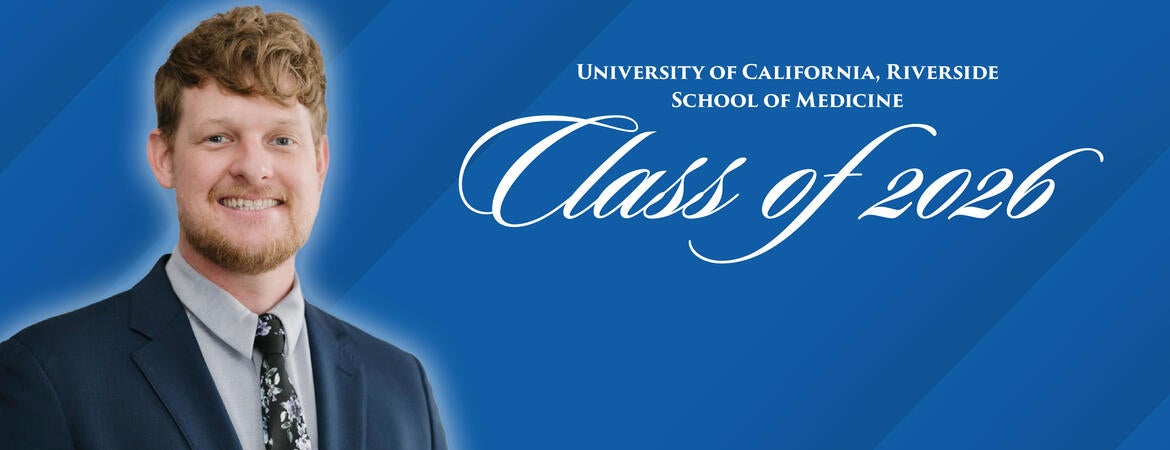
When Andrew McLain started at the UC Riverside School of Medicine in 2020, he was sure of one thing: He did not want to specialize in emergency medicine. For the former emergency medical technician (EMT), “I initially told myself I wasn't going to do emergency medicine because as an EMT, there's a very short window of somebody's care that you see, and I wanted to see more of the long-term side,” he said.
Caring for patients in emergency situations was closely tied to his dream of becoming a physician for McLain, SOM Class of 2026. McLain’s older brother, Ryan McLain, worked as an EMT when McLain was a child and often told him stories about helping stabilize patients in critical situations. “It was such a dramatic change in this person's life; if they and the physicians hadn't been involved, this person probably would have died,” McLain said. His brother’s experiences spurred McLain toward a career as a physician, including working several years as an EMT himself in college before starting medical school.
The road back to emergency medicine
McLain thought he would become a surgeon. But as he completed his medical student rotations, he rediscovered the aspects he’d loved about being an EMT. “You get this patient that’s totally undifferentiated in a lot of ways and it's a puzzle--you have to figure out what's going on and do something to help that person,” he said.
While it wasn’t the long-term care he was seeking, McLain found satisfaction in easing patients’ discomfort. “You can have somebody come in with a headache or nausea and you can give them something to make them feel better, and even if you're discharging them there's a big impact on that person's day or even life,” he said. “That's something that I really resonated toward.”
McLain realized that he’d be able to help people on one of the worst days of their lives just as he had as an EMT, but with more tools. Rather than improvising in a patient’s home, “You could take this limited picture that you're given in the field and expand upon it, then do all these other intervention techniques that not only will stabilize somebody but could potentially correct something that was going downhill fast,” he said. “That’s the biggest appeal,” he added, “and then as a physician, being the end all, be all of the team, and being able to make the decisions and utilize the team to hopefully help this patient the best I can.”
Taking the mandatory ultrasound course as a first-year medical student, then teaching it as the director of the Ultrasound Student Instructor Cadre (USSIC) during his second year, also drew McLain back toward emergency medicine. Imaging, he said, can help transform patients’ trauma from a “blank slate” to recognizable issues. “I hadn’t put my emergency medicine hat on yet, but once I did, I realized it made sense why I liked ultrasound so much and why these pieces came to fit into place,” he explained. “I like being able to take care of somebody hands on, right now.”
A unique path through medical school
Unique challenges and life experiences also shaped McLain’s career aspirations. After entering medical school in 2020, he took two years off following a head injury and shoulder surgery. Newly married at the time, “I got to spend time with my wife and do some traveling as I was rehabbing and taking time to study for my exams,” McLain recalled. “At the end of the day, that's time that I will always cherish.”
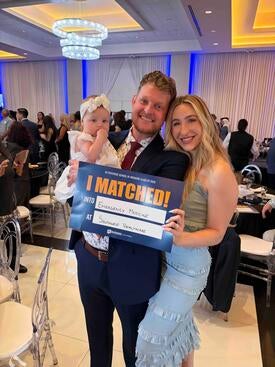
Then, during his fourth year, his wife Mariah McLain had their first child. “I realized that things that are important to me now were maybe not what were important to me when I started med school,” McLain said. As a new father, clocking in and out for defined shifts in the emergency department became more attractive. “As I’ve become a husband, as I've gotten older and now become a dad, I've realized that at the end of the day I want to be a dad and husband that happens to be a physician, instead of a physician that happens to be a dad and a husband,” he said.
Conversations with his mentor Hanh Nguyen, MD, FAAFP, associate dean of Career Advising, also influenced McLain’s changing perspective.
With four young children himself, “We shared parenting tips and commiserated over the many sleepless nights with a newborn,” Nguyen said. “Most importantly, I always wanted Andrew to know that while he will be an amazing physician, he still has the most important people to see at the end of the day after he sees all of his patients at the hospital, and those people are his baby and family.”
Despite the added challenges he overcame during medical school, McLain said he wouldn’t change anything. “I'm who I am now because of the things that I've experienced,” he said. “Some bad things like my head injury, but some really good things, and I would go through being a fourth year med student with a baby a million times over.”
Remembering his roots as a community physician
McLain will begin his emergency medicine residency program in his hometown of Temecula at Southwest Healthcare Temecula Valley Hospital this summer.
“Andrew serves the mission of the SOM to train physicians who will address the health disparities in a medically underserved region,” Nguyen said. “More importantly, he will do so in an area that he calls home and has well-established roots with his baby.”
“I just want to be able to be a good doctor that takes care of my community, and there's no better way to do that than being an ER doctor,” McLain said. He’s open to pursuing a fellowship or other opportunities at some point in the future. For now, “I think really it’s just being a good doctor and a good cornerstone of my community,” he said. “If I can achieve that, I think I'll be satisfied in my career.”
From all his life experiences, including his time as an EMT working in impoverished areas, McLain said he’s gained a strong sense of empathy. “Having been in situations where it’s like, ‘Hi, I'm Andrew, I'm an EMT, this is the worst day of your life, let's have an interaction,’ I think just my ability to stay calm and still be able to empathize and socialize and interact with people is probably the biggest gift that I took from my time there,” he said. “As I approach my future patients, I’ll try to reach back and maintain that nonjudgmental advocate role as a physician.”
“I try to joke with my patients if I can… in a way that lets them know, I'm here for you, let's try to find some bit of happiness in all this craziness,” he continued. Acknowledging that there’s a time and place for seriousness versus humor, he said, “I think laughter is the best medicine, so if I can take them out of their headspace, or the fear that they might be in, I think those are the best interactions that I've had so far.”
Based on his own experiences having his input as an EMT dismissed by a medical team, McLain added that he’ll strive to treat everyone equally. “I don't ever want to look at anybody and say, ‘Oh, you're just this,’ because I was ‘just this’ person at a certain point in my career,” he said.
McLain’s brother Ryan, who’s now a firefighter, often reminds McLain to remember his roots. McLain always assures him that he will.
“My biggest takeaway is that at the end of everything, we really are the sum of our experiences,” McLain said. “I failed at this, succeeded at that, and I lived through it and that's who makes me who I am,” he continued. “I think I'll be a better doctor today versus last week because of what I've experienced, and a better one next week versus today for the same reason.”