Since 1876, the Association of American Medical Colleges (AAMC) has served as the national association representing more than 400 accredited medical schools and teaching hospitals. The non-profit organization is perhaps best known for administering the Medical College Admission Test (MCAT), overseeing the AMCAS centralized application service, and National Resident Matching Program (NRMP).
What isn’t as well known to people outside the field is the role the organization plays in setting the priorities, initiatives, and agendas that affect medical education, research, and practice across the country. Further, it is the staff, faculty, and students from the member institutions who play a major role in guiding this growth through participation in AAMC affinity groups program.
The AAMC describes these groups as a “valuable source of professional growth, leadership development, networking, and collaboration for the individuals at our member institutions. Affinity group members are people at the heart of America’s medical schools and academic health systems who power the various leadership, administrative, clinical, education, community, and research functions needed to advance the missions of academic medicine.”
In exchange for their service, participants gain experiences that help them move from a contributor to a decision maker.
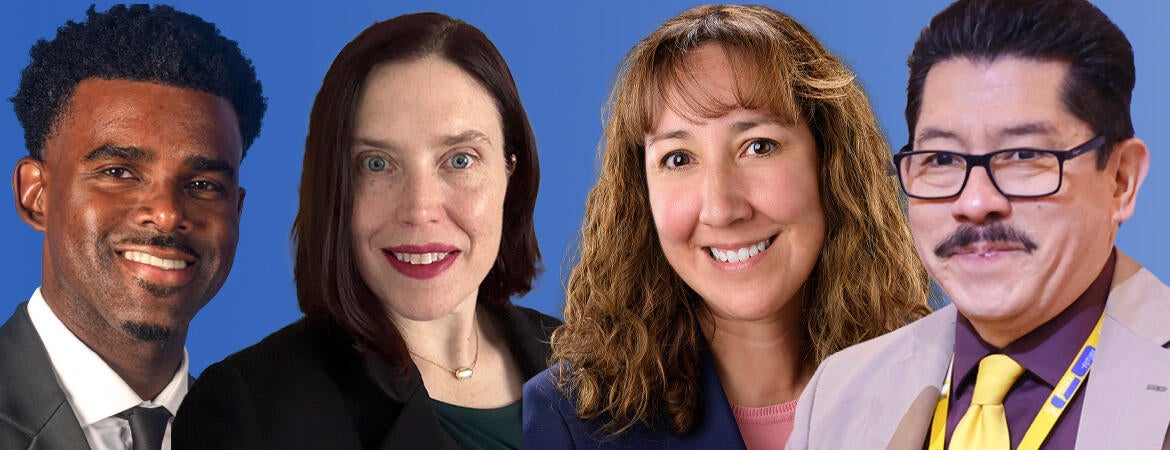
Four members of the UCR School of Medicine have been appointed to affinity groups for the 2026-27 year. They are:
- Vladimir Oge, director of Strategic Initiatives, who was named marketing chair of the External Relations Group Steering Committee.
- Pablo Joo, MD, senior associate dean of medical education, who was named member at large of the Curriculum, Assessment, Instruction, and Research Group Steering Committee.
- Christina Granillo, PhD, associate dean for student success, who was named a member of AAMC's Learner Access, Support, Opportunity, and Retention Group Student Advising, Support, and Records (SASR) Committee.
- Katherine Browder, chief of staff and assistant dean of Strategic Initiatives, who was named member at large of the Planning and Operations Group (GPO), serving as a liaison between AAMC's Planning and Operations Group (GPO) and the chief of staff community.
"I chose to get involved in AAMC because I saw it as an opportunity to learn more about best practices that could be brought back to the UCR SOM," Granillo said. "A huge benefit is you gain access to a larger community. For example, if I am working on a policy, I can reach out in one email to a group of people and ask how they created a similar policy. The community is truly invested in helping one another and freely sharing ideas."
Oge said he chose to get involved after attending his first Group on Institutional Advancement (GIA) conference in 2022.
"I was still fairly new to the field, and I was interested in networking and learning more about communications and marketing within academic medicine. I found the community to be incredibly welcoming," he said. "I realized that volunteering with AAMC would be a great professional development opportunity to continue growing as a servant leader. Since then, I’ve accelerated my understanding of academic medicine, particularly with respect to communications, marketing, community relations, alumni relations, and development—all areas that have helped me in my role with the UCR School of Medicine."
This year, the AAMC revamped their affinity groups, transitioning to a model with 11 strategic, purpose driven groups. The new groups are more collaborative, easier to navigate, and better aligned with the priorities of their constituents. The changes are directly tied to the changes in academic medicine, and the new group structure will better reflect the professional needs of people who work in the field. Granillo said that the opportunity for systemic change is exciting.
"The work of this inaugural committee is important because it brings a comprehensive approach to how medical schools support students from matriculation to graduation," she said. "As this is an inaugural committee, I am excited to see both the new work that can be done to support students, and the work that was happening in the previous Committee on Student Records that I was on."
Browder echoed those sentiments.
"More than anything it is a huge network of colleagues across the US that I can learn and share from within my field. I have had the opportunity to meet chiefs of staff from across the country and who bring unique perspectives and experiences that strengthen the entire academic medicine community," she said. "Part of my personal mission is not only to learn as much as I can, but to share this learning with others and my organization to drive towards more mission success."
Browder recalled the reward she felt after audience members approached her at her presentation at a recent Group on Institutional Planning (GIP) Conference.
"I had people tell me that they immediately went and talked to their colleagues about how to implement some of our ideas we shared," Browder said. "That really made me feel like I had made a valuable contribution within the academic medical community in a tiny way."
Each of them encouraged members of the SOM community to apply to join an AAMC affinity group if they feel the call to do so.
"As you get involved, you'll realize you are qualified because you bring expertise from your role with the UCR SOM that is valuable to others," Granillo said. "When you get involved in the AAMC it brings perspective as to how much the SOM accomplishes and how have a lot to share with others."