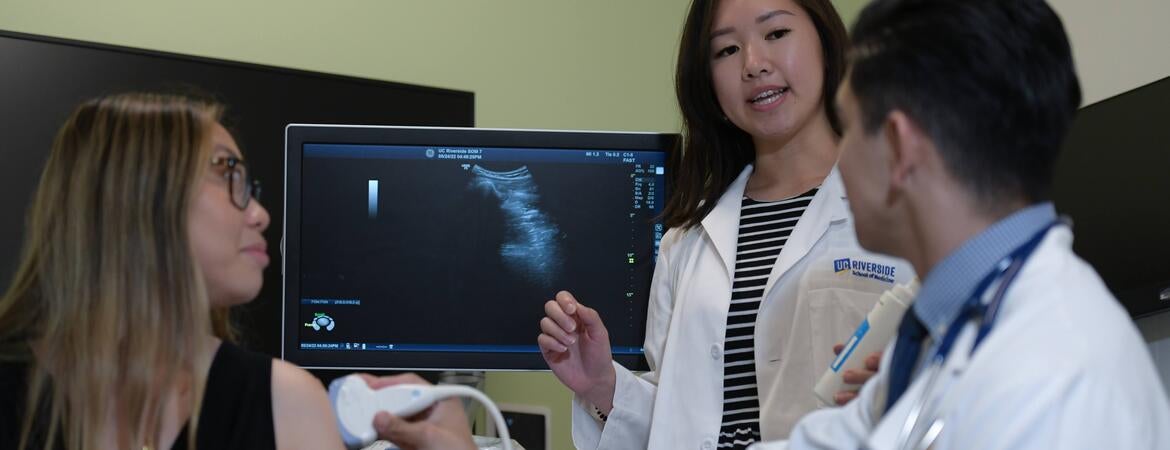
During a recent career day at a local high school, second-year UC Riverside medical student Leonardo Padilla stood in a classroom with an ultrasound probe in hand, surrounded by students staring in wonder at the image of the inside of the body appearing on the screen in front of them. Looking at the faces of the students, Padilla was reminded of his own early ambitions to become a physician.
Padilla was visiting the school in his role as an instructor as part of the UCR School of Medicine’s Ultrasound Student Instructor Cadre (USSIC), a program in which second-year medical students teach first-year students about point-of-care ultrasound and also participate in community outreach programs.
Ultrasound, also known as a sonogram, is a non-invasive imaging technique that uses high-frequency soundwaves to create real-time images of the inside of the body. It is safe and painless and is becoming much more commonly used tool in physicians’ offices.
As Padilla demonstrated the device, he drew connections between the physics that made medical imaging possible and things that students were already familiar with, such as echolocation in bats and sonar used by whales and dolphins. “Watching students make those connections in real time was honestly one of the more rewarding teaching experiences I’ve had,” he said.
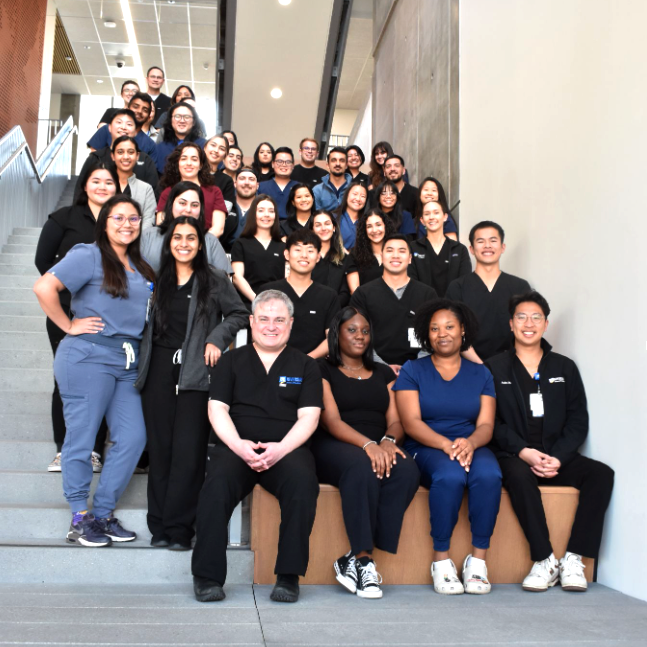
The USSIC program’s curriculum runs alongside the first-year medical student class schedule. So when students are learning about cardiopulmonary anatomy in lecture, they are receiving the corresponding instruction in ultrasound instruction. “The clinical goal is to help our medical students obtain proficiency in point-of-care ultrasound to enhance their future patient care,” said Lucas Friedman, MD, the UCR SOM ultrasound thread and designated emphasis director, who has overseen the program since 2018. “Ultrasound can help bring anatomy to life for a student.”
One step ahead
Before second-year students can become USSIC instructors, they undergo a rigorous selection process. Over the summer, candidates complete online modules, examinations, and probe cases, log hands-on scanning hours, and participate in the Ultrasound Games: a team-based assessment of both clinical competency and teaching ability. Once selected, instructors choose to join one of five USSIC committees, including Education, Research, Community Outreach, Probe Scholars, and Technology, each with its own role in keeping the program running.
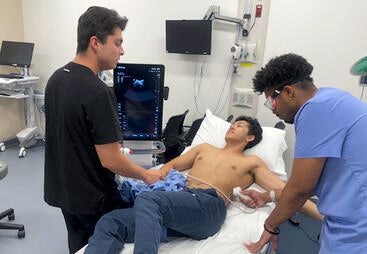
in 2025. Teams must communicate how to obtain
a view to a teammate that cannot see, which
tests their teaching skills.
When the academic year begins, the new instructors lead teaching sessions for the incoming first-year class. Sessions open with a live lecture introducing core concepts, followed by a quiz game to keep students engaged and test their understanding. From there, students move on to the SOM Center for Simulated Patient Care, where the first-year students work in small groups as USSIC instructors guide them through each component of the process.
For students like Padilla, stepping into a teaching role has changed how he engages with the material. “The moment you have to articulate why a structure appears the way it does sonographically… you quickly discover whether your understanding is genuine,” he said. The MS1s push that process further by asking him questions that keep him sharper than any passive review ever could.
First-year SOM student Analynn Lechien said the peer teaching model made a meaningful difference in how she learned. “The program did a good job having the second-years teach us, because they just went through it themselves – they know what we struggled with,” she said. “If a professional had taught it, they might have said it too intricately. The MS2s really broke it down in terms that made it easier to understand.”
Friedman sees this dynamic as central to the program’s design. “A second-year demonstrating how to obtain a view of the heart shows a learner that this skill is obtainable,” he said, “much more than a board-certified physician with years of experience.” The approach is grounded in educational research, drawing on principles like self-determination theory and growth mindset to create an environment where students feel motivated, supported, and able to develop genuine competence.
That hands-on learning has a way of clicking into place. During a musculoskeletal session, Lechien recalled watching her group’s reaction when they saw their muscles moving in real time on the ultrasound screen. “Everyone was like, 'Oh my gosh, we can see it moving,” she said. “That’s when ultrasound started clicking for me.”
Padilla’s own draw to the program came from his passion for trauma surgery and a background in emergency medicine, two fields in which point-of-care ultrasound is too consequential a skill to leave to chance. “Being offered the opportunity to train before the clinical years felt like a true advantage,” he said.
Yet Padilla’s ease in front of the room didn’t come automatically. “There’s sometimes a feeling that you need to know everything perfectly to teach effectively,” he said. “But I’ve learned that’s not true, you’re just one step ahead in the learning process.” What made the difference, he said, was the collaborative culture within USSIC, knowing he could turn to fellow MS2s when he was unsure of something. It was, he added, a testament to the environment Friedman has built within the program.
The other side of the probe
On the other side of the probe, the experience is equally valuable. Nathan Hillyer, a fourth-year biology undergraduate at UCR, first heard about the Probe Scholars program through Mini Medical School, a UCR School of Medicine Pathway Program. When a recruitment email came through the organization, he and a friend jumped at the chance to learn more, which recruits undergraduate volunteers to serve as patient models for medical students practicing ultrasound techniques. Neither of them expected how much it would come to mean.
Now serving as a recruitment lead for the Probe Scholars, Hillyer said the program offers something most pre-health students never get elsewhere. “You’re getting direct access to medical students and faculty, attending events alongside them, and learning things about medical school that you genuinely cannot find anywhere else,” he said.
What surprised Hillyer most was how technically demanding ultrasound is. Staring at a screen full of unfamiliar black and white shapes, he said, gave him a new appreciation for what the medical students were working through, and watching them adapt with hands-on guidance only deepened that respect. But the small group format made the learning environment feel accessible. “As a pre-health student, being in a room with medical students who are in the exact position I am working toward is something really special,” he said.
His appreciation grew even further through events like the Extended Focused Assessment with Sonography for Trauma (eFAST), a collaboration between USSIC and the Emergency Medicine Interest Group. At the event, Probe Scholars learned about real clinical scenarios and practiced scanning firsthand. “Getting to develop that skill firsthand was an experience that I will never forget,” Hillyer said.
Building for the future
Beyond the mechanics of scanning, USSIC is designed to build something harder to teach in a lecture hall: the ability to reason through uncertainty in real time. “Developing the ability to interpret what you’re seeing in real time, under the kind of uncertainty that clinical medicine routinely presents, is difficult to replicate in a lecture,” Padilla said. “USSIC creates the conditions to practice it early.”
That vision extends well beyond a single year of training. Through the Core Integrated Training in Ultrasound (CITrUS) Academy and a Point-of-Care Ultrasound (POCUS) Designated Emphasis, students build on their training every year – from foundational imaging as first-year students to specialty-focused proficiency by the time they graduate. Friedman said he sees room to grow further. “I see an opportunity for UCR SOM to collaborate more regionally with other medical schools,” he said. “I am excited to see how this model can grow in the future and have more impact throughout our region.”
For Padilla, the program has come to mean something beyond clinical preparation. “USSIC has been one of my favorite parts of medical school,” he said. “It helped me rediscover my love for medicine that can sometimes get buried under the sheer volume of the curriculum. Being able to teach it, share it, and watch others get excited about it has kept that spark alive for me.”