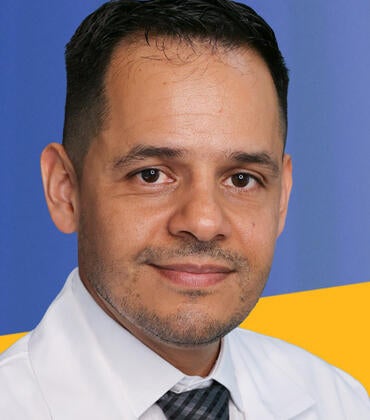
During one of his pediatrics rotations in medical school, Javier Prieto encountered a young patient with a tumor growing in his kidney. “His relatives had already had kidney problems, so hearing that his kidney would be taken out caused fear within his family,” recalled Prieto, who will graduate from the UC Riverside School of Medicine in June.
Speaking with the family in Spanish helped Prieto reassure them. But Prieto took it a step further. He, too, had a kidney removed as a child--and grew up healthy. “For me to share my story with the patient at that time, I felt a sense of relief on his end and he also said that he wanted to be a doctor when he grew up,” Prieto said.
“I saw myself in him, and I hope he saw himself in me,” Prieto continued. “With our similar backgrounds, I hope that really instilled a moment of belief and trust that he could do it too.”
Pursuing urology at UCR
Born prematurely at seven months, Prieto had an under-developed kidney that needed to be removed. His frequent kidney procedures throughout his childhood inspired his dream of becoming a urologist himself. “With me seeing urologists growing up, it made sense to me and I never looked back,” he said. “I didn't really choose my specialty, I feel like it chose me.”
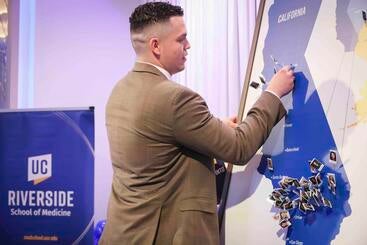
A deep connection with his pediatrician, Daksha Jain, MD, whom Prieto saw until he turned 21, also influenced his goal. “In kindergarten, I gave her a school picture and I told her I wanted to be a doctor just like her,” he said. “My pediatrician always being there for me, and seeing how she treated me with deep care and always wanted to know what was going on beyond my medical conditions, really inspired me to always do the same for my future patients.”
Growing up in Victorville with family throughout the Inland Empire, Prieto chose UCR for medical school with the hope of serving the local immigrant community. Yet with few medical students pursuing the niche urology field, Prieto had to find his way down the less common route.
Thanks to help from UCR staff, particularly the Office of Career and Residency Advising, Prieto gained access to faculty physicians, a summer program in urology at UCLA, and research opportunities. “That really set the path for me to make the connections elsewhere that helped me along the interview process and the residency application trail,” said Prieto, adding that he was only the third UCR SOM student to match into urology in the school’s 10-plus year history.
Prieto also had to navigate the challenges of being a first-generation college and medical student. While his family supported his dreams of becoming a doctor, they lacked the experience with his career path to help him overcome difficulties during medical school.
Mentors like Hanh The-Trinh Nguyen, MD, FAAFP, associate dean of Career Advising, stepped in to fill the gap. “Dr. Nguyen always offered me an open door policy and… if I wanted some advice within a rotation, whatever I needed to talk about, he was always there for me whenever I needed,” Prieto said. “That just shows the passion that the UCR physicians and faculty have for their students.”
Nguyen also helped Prieto with his residency application process, including with drafting his personal statement and practicing mock interviews. “Javier's passion for helping those in the community that he grew up in as a urologist will provide a source of hope and inspiration in a medically underserved area,” Nguyen said.
A commitment to patients in the region
Connecting with local patients while completing his rotations and working at the Riverside Free Clinic also strengthened Prieto’s desire to give back to the area. Coming from a Mexican immigrant family, he understood the difficulty of navigating the U.S. healthcare system. “My family goes to the county hospital, so when I rotated in the emergency department there I really felt that I was serving my own family, and that I was really making a difference in my cultural background with the majority of them being Spanish-speaking patients,” he said. “It solidified my lifelong goal of becoming a urologist.”
Prieto matched into a urology residency program at St. Joseph's Medical Center in Stockton but hopes to eventually practice in the Inland Empire. “To return home and serve where I grew up would be amazing, in the area that UCR is really trying to improve,” he said, furthering the SOM’s mission to expand healthcare access in the underserved region.
For Prieto, an important aspect of healthcare is developing trust between patients and physicians. “Especially for men, going to the urologist can be scary, not only from a physical health standpoint but because there's sometimes feelings of embarrassment,” he said. He added that medical misinformation online also erodes patient trust. “Urology is definitely going to have a more sensitive, intimate, and personal type of relationship with patients, so building that trust and letting that patient know that you're willing to see them across whatever span of time they need, that's very encouraging for that patient,” Prieto said.
He plans to continue sharing his story with patients to build connections and strengthen trust. “It's nice during a moment of uncertainty or fear that I'm able to talk to patients and say that I also had surgery, I also have been living life with one kidney for a very long time, and everything's been OK,” he said, calling a kidney removal just a “bump in the road.” “That patient's going to feel heard and seen and connected to that physician, and I don't think that's something our patients are going to forget."
Prieto still holds onto his kindergarten dream of serving patients just like his pediatrician did. He remains in touch with her through phone calls. “She emphasizes that throughout your medical career, you’re going to have tough times, but it’s the relationships and the stories that the patients share with you that keep you going and remind you why you're doing what you're doing in medicine,” Prieto said. “We're not always saving lives; our impact goes beyond that,” he added. “To see them fight against that disease, and then see them blossom from there, this is why we do medicine.”