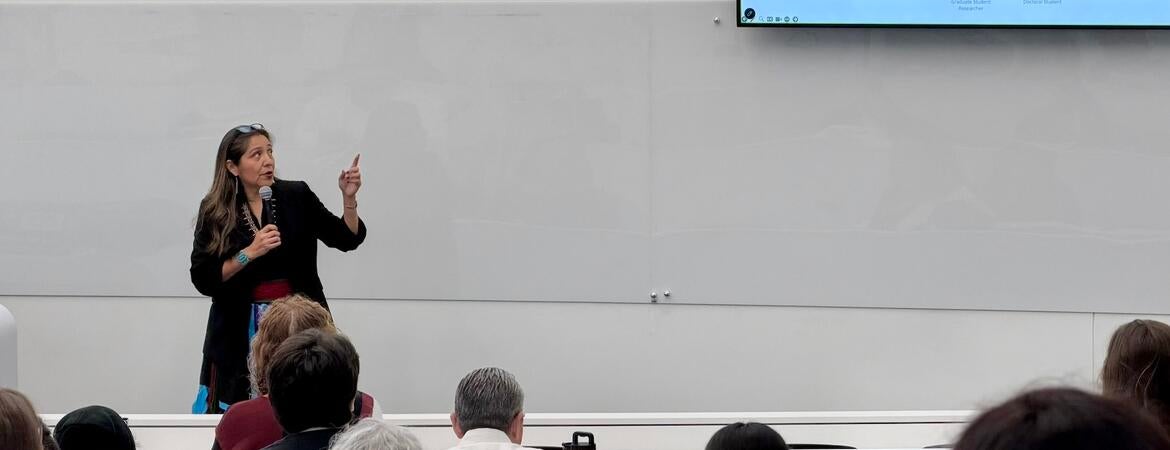
The UC Riverside School of Medicine Office of Diversity, Equity, and Inclusion hosted a lunch and learn on Thursday, November 19 in honor of Native American Heritage Month in November. More than 50 people attended the event, which featured a lecture by Claradina Soto, PhD, MPH, an associate professor in the Department of Social Medicine, Population, and Public Health with Jemez Pueblo and Navajo ancestry.
Soto’s talk, “Nothing About Us Without Us: Community-Based Participatory Research with Tribal and Urban Indian Communities,” focused on the importance of including Native Americans in the research process when collecting data and creating interventions in their local communities.
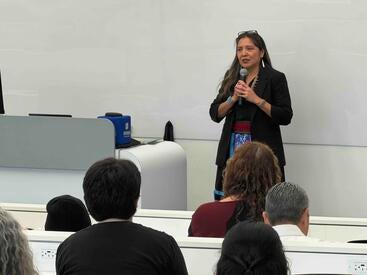
Engaging with community members is particularly important, Soto said, because researchers have taken advantage of Native American communities in the past. She shared one example from the early 1990s where academic researchers collected blood samples from Havasupai tribal members for diabetes research, then reused the same samples for other research studies without approval. “What's wrong about this is that one consent form was treated as permission for future use,” Soto said, adding that the tribe successfully sued in 2004. “The other thing wrong was there was no return to the community before reusing this data--you have to share back, and you have to include them honestly.”
Research is critical for understanding and addressing health disparities in Native American communities. Statistics indicate issues including high rates of diabetes, overdose deaths, and substance use among Native Americans in California compared to other groups in the state. Yet Soto emphasized that involving community leaders and members is equally essential when gathering data. “We're invisible in the data. Racial misclassification undercounts us and underestimates our need,” she said.
Despite Soto’s own background, she said that it sometimes takes her years to gain communities’ trust. In the past, she shared that Native American leaders would hang up on her as soon as she mentioned the word “research.” “Just because I'm full-blooded Native doesn't mean anything if I'm not from their community,” she said. “I have to earn that trust.”
Soto explained the main principles of community-based participatory research that she applies to her own projects, including learning tribal health perspectives, training and paying for community members’ time, and sharing findings. Establishing a long-term commitment, Soto added, is also important. One program she helped develop “reached many communities, but that funding ended, and now communities are reaching out wanting it but I don't have the funding,” she said. “Those are definitely some challenges in this work.”
In her presentation, Soto described her six current projects: HPV Vaccination Pilot with Riverside San Bernardino County Indian Health Inc. (RSBCIHI), Vaping Endgame: Culturally Adapted Randomized Controlled Trial (RCT) for American Indian Youth, Traditional Health Care Practices Statewide Evaluation, Culturally Informed Patient Navigation, Smoking Cessation RCT with the University of Minnesota, and Tribal Medication Assisted Treatment (MAT) Projects.
She shared an anecdote from her HPV vaccination study that illustrated the importance of the work. The project’s goal was to improve HPV vaccination rates among American Indian adolescents, and included an advisory board made up of clinic providers, staff, and community members. But when the researchers first began describing the benefits of the vaccine, a clinic staff member spoke up to say she didn’t want it. “I said, ‘OK, that's why we're here; we want to learn from you all,’” Soto recalled. They gave a 15-minute talk on the vaccine’s importance, and at their next meeting, the same staff member told Soto that she got all her kids vaccinated because of the talk. “Public health education is so key… that is how important it is to engage community, listen to community,” Soto said. The team later used data gathered from the study to create a training for providers and clinic staff to better communicate vaccine knowledge with parents to increase HPV vaccination rates.
Soto’s other projects have also made a difference and highlighted the trust she’s built within Native American communities. For example, after identifying an issue of high rates of commercial tobacco use among Native American youth in Northern California, her team conducted a needs assessment in 2021 and applied for funding. A community advisory board and youth advisory council helped adapt a youth vaping curriculum for Native youth in the area. The pilot program was successful, but it was the community’s response that stuck with Soto. “It was so cool that the community members said, ‘You came back’… and that truly touched my heart because they know how far we’re traveling but they also knew how important this work was,” she recalled.
Soto plans to continue her research alongside communities and hopes to create a center at UCR. “My vision is… engaging cross-collaboratively with different departments within UC Riverside, but also with our students, our faculty, our staff to really work with not just this community, but any other historically marginalized communities,” she said. “Some of these disparities are absolutely real, and there are solutions, but they have to be with our communities.”