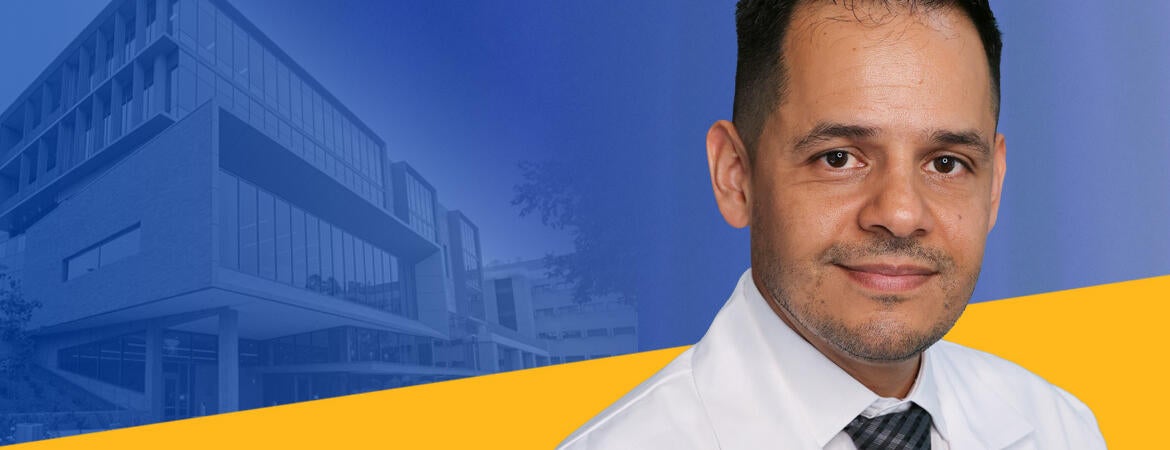
When a patient transferred from a behavioral health hospital to Dignity Health St. Bernardine Medical Center in San Bernardino, UCR family medicine resident Isaac Morones, MD, knew she needed surgery. A common procedure would adequately treat her condition. But Morones, a physician from Mexico recertifying to practice medicine in the United States, knew it wouldn’t account for her mental health condition and living situation in a correctional hospital. “The support system wasn't in place for this type of population, and I thought she was not a really good candidate for that procedure,” he recalled.
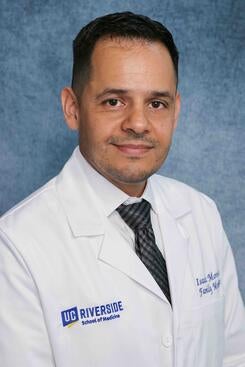
Working with the surgical team, Morones was able to schedule the patient for a more suitable operation. “The problem was resolved in the same admission, because of that conversation with the whole team,” he said. “It's a good feeling, and… that's why I'm doing this.”
As a doctor who trained and practiced in Mexico, Morones was accustomed to advocating for his patients and finding ways to aid those facing challenging circumstances. “There are different ways to do things in Mexico because we have less resources, and that helps you to be creative and to be resourceful,” he said. “That's a challenge, but if you have a really strong intention to treat the patient, it's going to help you to find a way.”
While the U.S. has more resources, he observed that he could play an important role in underserved communities like the Inland Empire that may still lack access, especially for patients that could not afford insurance. “For patients here… instead of just closing my mind and saying there's nothing we can do, I can advocate and say… maybe we can try this other medication, or maybe in the meantime we can try this strategy,” he said.
But with his international degree, Morones first needed to earn a U.S. medical certification to practice in the country, a step that involved passing exams and completing a U.S. residency program.
Becoming a doctor again
After working in Mexico as a doctor since 2011, Morones moved to California with his wife and two children in 2016. They hoped to offer their kids more educational opportunities and for Morones to achieve a better work-life balance.
Morones continued treating patients in Tijuana from 2016 until 2021, eventually stopping to spend more time with his family. He worked as a case manager in San Diego for a few years before deciding he wanted to continue his medical career. After passing the United States Medical Licensing Examination (USMLE) Step 1 and Step 2 exams, Morones enrolled in UCLA’s International Medical Graduate Program in 2024 to better understand the U.S. medical system through clinical rotations and to improve his chances of matching into a U.S. residency program, a requirement for doctors with international degrees.
Upon completing UCLA’s program, Morones matched on his first attempt into UCR’s family medicine residency program. The program was a perfect fit for Morones, keeping him close to his family while giving him the opportunity to learn a new primary care field and use his native Spanish language skills in a state where 40% of the population, yet only 6% of physicians, are Latino. “The Spanish-speaking population in Southern California is really high in number, so I wanted to serve the community that doesn't feel fluent in English in the same way I feel,” he said.
“One thing that really shines through with Dr. Morones is that he really cares a lot about his patients; he has a way of communicating with them that's very warm, and he meets them at the level they're at,” said Kenneth Ballou, MD, director of UCR's Family Medicine Residency Program. “He's a very accomplished physician, and… all of his life experiences and educational experiences up to this time have contributed to making him a really special doctor.”
A specialty to help people
Morones’ new family medicine specialty built on his original specialty of internal medicine, a similar primary care field focused on adult patients. “Internal medicine was a good balance between patient interaction, and also I think it's a really good opportunity to create this connection with the patients,” he said. His initial specialty choice evolved from Morones’ early career aspirations of becoming a missionary, all stemming from his ongoing goal of helping people.
Rather than waiting to treat patients who became critically ill, “I wanted to prevent those complications from going to the hospital, and I wanted to help people to change all the habits that will lead to those complications,” Morones said. “That's the greatest challenge because it depends on the patient behavior, the patient education, the patient habits, and that's even more difficult to change.”
Preventive medicine often goes unseen, he continued, but it’s just as important as other care. “It doesn't look as dramatic as saving a patient in the hospital and doing CPR, but it actually impacts more lives if you’re really committed to improving and preventing those complications,” Morones said.
New opportunities to learn
Entering his new residency program in family medicine could sound like a step backward after working as a physician for years. Yet for Morones, it was an opportunity to enhance his skills to serve a greater variety of patient populations, all while holding himself to an even higher standard than before. “No learning is useless,” he said. “It doesn't matter if you did residency once, twice, three times before, nobody knows everything, and there's always an opportunity to improve. So I think it's very important to have that mindset of being humble and letting the patients teach you.”
As a member of the first cohort of the SOM’s family medicine residency program, Morones has been completing his residency requirements at UCR Health and Dignity Health St. Bernardine Medical Center in San Bernardino. He said that residency is still challenging even the second time around, but that his previous work prepared him well. “In Mexico we work more hours, we see more patients, it's physically very demanding, and the fact that I set my mind to a high demand setting helps me to cope with the stress,” he said. “I'm not trying to say it's super easy because it's not… it just requires commitment, and I feel it's a very good balance.”
Morones also appreciated the chance to complete quality improvement projects as part of his residency program and to work toward his own research. “I love learning, and I want to understand, and I want to make things better,” he explained. His quality improvement projects focus on reducing the misuse of antibiotics, such as those improperly prescribed for viral infections, and determining appropriate referrals for knee pain to obtain needed care for patients without unnecessary tests. In the future, he hopes to work on research to improve the health of the geriatric population and to prevent common medical complications.
Connecting with patients
Morones said he enjoys being able to use his Spanish abilities to improve medical care for underserved patients, noting that it can be easier to create connections and understand symptoms through a shared native language. “When you talk to somebody and it’s not your language, you limit your expressions because you don't know how to express certain things, but when you're talking to somebody in the same native language you're able to better express what your concerns are,” he explained. He added that he has connections with many patients from the variety of places he’s lived or worked in Mexico, from Mexico City to Tijuana. “Being a doctor is not only about knowledge, it's also about connection, and I think that improves healthcare outcomes,” Morones said.
“Bringing his Spanish skills, both spoken and written, to this community gives us that opportunity to be able to provide adequate care,” said Blanca S. Campos, MD, a faculty member in the family medicine department who works with Morones. “I think that's the goal of having a diverse residency: It makes the program stronger and also the patients feel that they're well taken care of when they could be seen by a doctor that understands and speaks their language.”
Morones intends to continue caring for underserved patients. “It’s rewarding to help somebody,” he said, “and in underserved populations, there's a lot of opportunities to help.”