Most master’s programs have a thesis or capstone project showcasing tools and knowledge that students gained during the program. The final project for the UC Riverside School of Medicine’s new Master of Public Health (MPH) program, however, takes it one step further.
For their capstone projects, each MPH student works alongside a local organization to create a project or proposal that will provide a clear benefit to the community. “It’s hard work to go out there and take your academic knowledge and work directly with a community organization and try to do something meaningful and relevant and impactful,” said Mark Wolfson, PhD, William R. Johnson Jr. and S. Sue Johnson Endowed Chair of the Department of Social Medicine, Population, and Public Health (SMPPH) who helped develop the MPH program. “There are a lot of hurdles and barriers, but the students who completed capstone projects were able to do it and I really admire them for that.”
From health literacy to mental health to care for unhoused populations, the projects by the MPH inaugural class of 2026 covered a wide range of topics. “They let us know that there are gaps in our knowledge about certain issues regarding public health in the Inland Empire, so there's policy and evaluation work to be done,” said Mario Sims, PhD, faculty director of the MPH program.
The capstone and thesis projects included:
- A Strategy to Address Latinx Immigrant Health Literacy
- Needs Assessment for the Reentry Population of San Bernardino County
- Association Between CDC Social Vulnerability Index Scores and Area-Level Mental Health Outcomes in Inland Empire ZCTAs
- From Trauma to Neurodegeneration: Exploring Biopsychosocial Links Between PTSD, Alzheimer's Disease, and Vascular Dementia in Marginalized Groups
- The Riverside Navigator Model: Developing and Evaluating a Community-Based Post-Discharge Stabilization Network for Unhoused Individuals in Riverside County
- Perceived Health Concerns for Latinos in Riverside County
- Behavioral Health Stigma and Help-Seeking Among Adolescent Student-Athletes
- Expanding Wound Care to Non-Clinical Settings: A Program Proposal for Serving the Unhoused Community in Riverside, California
- Voices of Exposure: A Digital Analysis of Burn Pit-Related Health Outcomes Among U.S. Service Members and Veterans
- Promoting Critical Health Literacy by Exploring Women's Health in Palm Springs
- Mental Health Literacy Capacity Among Promotoras Across Educational Backgrounds
“These capstone and thesis projects allow our students to demonstrate the knowledge and the skills that they've built throughout the program while preparing them to lead and make a difference within our communities,” said Cristina Gonzalez, a project manager in SMPPH. “It was rewarding to see their growth.”
Three projects are highlighted below.
A Strategy to Address Latinx Immigrant Health Literacy
Karina Young
Karina Young’s capstone involved creating a policy brief focused on educating Mexican immigrants in California about health literacy and necessary skills for navigating healthcare in the United States.
“U.S. Hispanic populations, in particular immigrant Latinx populations, have been found in many research studies to have low health literacy rates. This is a particularly glaring issue in California, a state with such a large immigrant population,” Young explained. “Language in health care is intangible, yet it can influence critical steps in a patient's doctor's visit.”
Her policy brief detailed the development of a mobile health app featuring health and educational materials created with guidance from community leaders.
“Our mobile app, Como Conseguir Salud, would be a resource required to be provided to each relevant person filing for residency in California,” Young said. “Latinos have been found to have a higher prevalence of chronic disease, so this intervention has the potential to greatly reduce the rates of chronic disease across California.”
“Being able to communicate with them in a language and with terminology that they can relate to is the foundation to helping them make a change that will help them in the future, and… also be able to advocate for themselves and their loved ones,” Gonzalez said of Young’s capstone. “A big component of our program was incorporating policy and how students can advocate and make a change not only from a grassroots level but from a policy and structural level as well.”
Young is completing her work contract with UCR's The Well department and plans to pursue government public health work at the city or county level. “The research may have led me here but mi comunidad anchored me to this topic, this population, this proposal,” Young said.
Expanding Wound Care to Non-Clinical Settings: A Program Proposal for Serving the Unhoused Community in Riverside, California
Jorge Delos Santos
Jorge Delos Santos drew on his past experience working for Riverside-based nonprofit TruEvolution for his capstone. “I wanted to see what other programs I could either develop or continue with locally, and I felt like that was going to enhance my programming, grant development, and grant writing,” he explained.
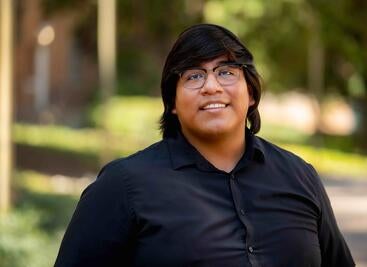
Delos Santos’ project created a proposal for a wound care program at Riverside Kansas Avenue Seventh Day Adventist Church near UCR’s campus. After completing his required program internship at the church during the fall of the second year of his MPH, Delos Santos continued volunteering there to help provide resources to the unhoused community. After an individual showed up with a dog bite injury and Delos Santos could only offer alcohol wipes and bandages, he asked the volunteer leader if they had considered providing wound care. From there, the program idea arose organically.
“I would just talk to people about how they would see this being set up… so it was slowly being built out by the volunteers,” Delos Santos recalled. “I never went in with the intention of doing my practicum and my capstone, but it naturally happened, which is usually how my work is,” he added. “Communities are the experts of what they do, and how am I going to tell some organization that's been doing this work for 25 years that I know how to do it when they're the experts?”
Delos Santos wrote the program proposal with grant funding in mind. “If a grant talked about theories and frameworks, I had a section with theories and frameworks; if they asked for a budget, I had a budget section,” he explained. “It was more of looking at their existing structure and then building out a program that will enhance it, because it was also about making it realistic.”
After graduating, Delos Santos accepted a position at San Bernardino Public Health Department focused on infectious disease investigations. Still, he said he’s continuing to volunteer at the church and hopes to see the wound care program implemented.
Association Between CDC Social Vulnerability Index Scores and Area-Level Mental Health Outcomes in Inland Empire Zip Code Tabulation Areas (ZCTAs)
Eliana Pandian
For Eliana Pandian, the MPH program stood out for its persistent focus on the role of environmental and other non-health factors in community health and mental health outcomes. When a mentor suggested she analyze health in the local area through publicly available data, Pandian pursued the idea.
Her thesis examined the link between social vulnerability and mental health outcomes in different zip codes in the Inland Empire. She hypothesized that higher CDC Social Vulnerability Index (SVI) scores would be associated with worse area-level mental health outcomes, and that proximity to universities would impact mental health outcomes.
Confirming her hypotheses, Pandian found a statistically significant link between poor socioeconomic status and mental health days. She also found that those who lived closer to a university had better mental health outcomes, which she attributed to the increased availability of resources. Still, she noted that this area in particular requires further research. “We see that university proximity has better mental health outcomes, so… Are the universities doing outreach to their local community to improve mental health access?” she asked. “And if so, how can we work with our universities or our local resources to get out into the more rural areas within the Inland Empire?”
A public policy PhD student presented Pandian’s findings at the 2026 Science for Policy conference when Pandian was unable to attend. Pandian is now working on publishing a paper. “The biggest gap was that not many people use the zip code level data to look at where you lived in an area and your mental health outcomes,” she said, noting that zip code research often focuses on infectious diseases or natural disaster preparedness. “The research gives us a tool as to which zip code areas and which areas within the Inland Empire we really want to focus our efforts on.”
Earlier in her education, Pandian studied key concepts in the field while earning her bachelor’s degree in public health at UC Irvine. “It wasn't until I got into my master's program that I felt that I was taking these ideas and concepts and really putting them into practice,” she said.
She added that the MPH program inspired her to pursue her PhD in public health or a related field. “Seeing all the amazing work by the professors, the school, the community really inspired me to want to further my education and also contribute to some of the amazing work that's being done,” Pandian said.